We were in Milan on October 14–15 for the FormuTech Summit 2025, where the most urgent challenges in RNA-LNP process development and manufacturing were actively tackled. The summit brought together experts driving the future of RNA-LNP field, spanning global pharma leaders, biotech teams, and academic labs. Discussions covered the full RNA-LNP therapeutics chain — from IVT innovations and scalable LNP manufacturing to formulation potency and analytical advancements. Across two high-impact days, FormuTech 2025 delivered a powerful snapshot of where the field is heading.
Date of the event: Oct. 14 to 15, 2025Where: Milan, Italy
Hot topics from FormuTech 2025
Scalable RNA-LNP manufacturing strategies: Modular and integrated production platforms are increasingly explored to enable robust scale-up while maintaining critical quality attributes (CQAs) across preclinical to commercial stages, providing flexibility and consistency throughout development.
Continuous pDNA-to-RNA-LNP GMP manufacturing: End-to-end continuous processing — from IVT synthesis, through chromatographic purification, to LNP formulation and final purification (e.g., TFF) — was a major focus at the summit.
Advanced QC & Orthogonal analytics for RNA-LNPs: Single-method analytics can be misleading; using orthogonal approaches is crucial for accurate and reliable RNA-LNP characterization. In addition, analytical workflows should ideally be scalable and compatible with multiple RNA payloads.
Challenges in EE% measurement: RiboGreen can be unreliable for accurately determining RNA encapsulation efficiency (EE%) in LNPs. To address this, alternative approaches are being developed, including two-dimensional chromatography, capillary electrophoresis-based method coupled with AI-driven data analysis, and emerging sensor-based predictive analytics
Further LNP characterization needs —Multi-payload LNPs & Empty vs. Loaded particle populations: Characterizing LNPs with multiple RNA payloads is complex, and accurate EE% determination requires advanced analytical techniques. Additionally, distinguishing between empty and loaded particles is critical to fully assess product quality and performance.
Regulatory considerations – Impurity profiling: Comprehensive characterization of impurities is increasingly expected, including their identity, removability, and impact on safety and efficacy. While absolute purity is unattainable, the focus is on understanding impurity nature, assessing toxicological relevance, and providing evidence-based justification.
Optimizing LNP performance: Innovations in lipid chemistry, formulation fine-tuning, and process parameters are still being investigated to maximize RNA-LNP potency.
AI-powered mRNA design can help optimizing key determinants (5′ cap analogues, 5′/3′ UTRs, nucleotide modifications, and poly(A) tail length and modifications) to maximize protein expression while preserving/improving RNA stability and reducing cytotoxicity. Furthermore, poly(A) tail engineering is being explored to extend mRNA expression for longer durations.
Emerging RNA technologies – saRNA & taRNA: Growing interest in self-amplifying (saRNA) and trans-amplifying RNA (taRNA) highlights their potential to achieve high protein expression at much lower doses than conventional mRNA through intracellular RNA amplification.
Thermostable RNA-LNP formulations: Developing RNA-LNPs that maintain CQAs during long-term storage at elevated or room temperatures has been discussed to improve global accessibility and distribution.
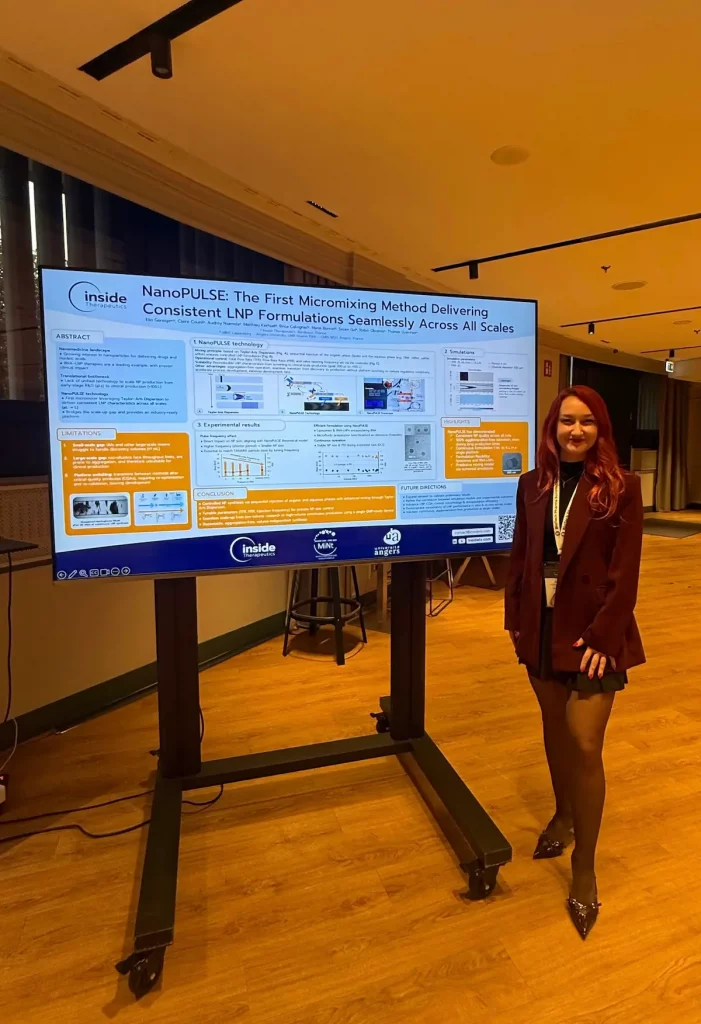
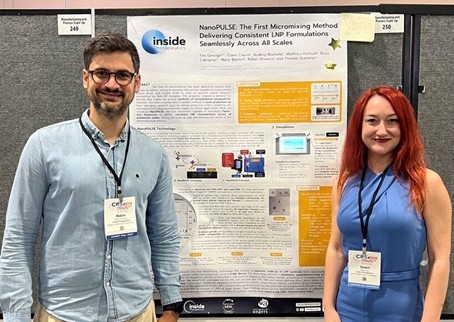
InsideTx Poster at FormuTech2025
Selected presentation highlights from FormuTech 2025
Find the highlights from our selected presentations below. Formutech 2025 introduced emerging technologies and insights that stood out as practical and forward-looking for the evolving RNA-LNP landscape.
cGMP manufacturing from pDNA to LNP with multiple payloads (Aleš Štrancar, Co-Director, Sartorius BIA Separations)
2D chromatography enables multi-CQA LNP analysis in one run, providing [1]:
Encapsulation efficiency and yield
Nucleic acid quantity and integrity
Average LNP size and size distribution
Differentiation of co-encapsulated cargo (e.g., mRNA/pDNA, different-sized mRNAs, or gRNA/Cas9 mRNA)
This method uses a switching chromatographic configuration composed of two distinct analytical columns (OH and SDVB reverse-phase columns), independent pumps, and dual detectors (UV–Vis and MALS).
One major benefit is that it enables direct analysis of LNP formulationswithout any prior sample preparation.
It can be used as an orthogonal to conventional methods, includingRiboGreen & DLS/NTA/Videodrop methods.
It also presents an opportunity to improve LNP analytics by enabling the assessment of more advanced CQAs, such as empty/full particle differentiation and mRNA–lipid adducts determination.
Note: Aldehyde impurities may form during LNP formulation or storage. As highly electrophilic species, they can readily react with RNA, significantly reducing mRNA activity. [2]
Next-gen cryo-EM based LNP characterization (Karl Bertram, Co-founder/Managing Director at ATEM Structural Discovery)
LNP morphology characterization with cryo-EM:
Reported morphological classes include solid core, bi-phasic dense, bi-phasic split, and multi-phasic LNPs.
Process throughput remains constrained by time-consuming, manual single-particle annotation.
AI-guided cryo-EM analysis is emerging to address manual bottlenecks in LNP annotation:
Automated morphology classification is being explored to increase throughput with single-particle precision, supporting morphology fraction quantification, size distribution, and LNP aspect ratio.
Future enhancements under discussion include full/empty LNP ratio analysis and targeting moiety detection.
Lipid composition influences morphological stability: In comparative stress studies (thermal, mechanical, and freeze/thaw), SM-102 formulations showed more pronounced morphological transitions than ALC–0315 formulations.
Formulation method affects morphology and biological outcomes: LNP formulations produced via alternative mixing approaches displayed different morphology fractions and potency profiles. In a further note, an increased fraction of blebbed/multiphasic structures did not necessarily correlate with higher transfection efficiency.
Like staying up to date? So do we.
Join the newsletter for the newest Reviews.
The next level in LNP size characterization: Efficient and non-destructive analysis with Spatially Resolved DLS (SR-DLS) (Ad Gerich, CEO/Managing Director at InProcess-LSP)
Limitations of conventional DLS:
Generates a single averaged scattering signal and one correlation function. In multiple-scattering regimes, this leads to invalid size outputs.
Requires static conditions, making it incompatible with real-time process monitoring.
Frequently relies on sample dilution prior to analysis since it necessitates optically dilute measurement conditions.
To overcome the limitations of conventional DLS, Spatially Resolved DLS (SR-DLS) has been developed as a powerful real-time Process Analytical Technology (PAT) tool. This technique:
Applies low-coherence interferometry and provides depth-resolved particle size measurements.
Uses advanced algorithms to isolate Brownian diffusion from flow-induced particle motion, allowing size determination during continuous processing.
How to improve LNP formulation potency by 1000X (Hui Liu, CEO, PrimaLux)
Potential factors contributing to LNP potency loss range from reagents, equipment, process parameters, RNA degradation, lipid quality/oxidation/ratios, post-formulation handling, assay variability, and mRNA-related factors such as coding sequence/capping/polyA tail.
Strategies identified to enhance LNP potency in this study include:
RNA contamination prevention (e.g., using RNase-free reagents, freshly prepared solutions, autoclaved glassware/spatulas, and cleaning benches/hoods with RNase removal solutions)
RNase inactivation with reducing agents (e.g., TCEP)
Endosomal escape optimization (e.g., via cholesterol derivatives)
AI-driven codon optimization
Greener, faster, smarter: Transforming RNA-LNP design and manufacture for the future (Juliana Haggerty, Head of Centre of Excellence – LNP, CPI)
Sustainable by design: RNA-LNP platforms offer rapid reprogrammability for vaccines and therapeutics, reducing development timelines and resource needs. Compact manufacturing further decreases overall energy use and resource consumption, while precision dosing limits material waste.
Environmental impact & Life Cycle Assessment (LCA): Analysis of RNA COVID vaccines revealed that transportation accounts for approximately 99% of total greenhouse gas (GHG) emissions. Within manufacturing, tangential flow filtration (TFF) was identified as the largest contributor to the carbon footprint.
Greener RNA-LNP manufacturing strategies: Approaches being explored include the use of biocatalytically synthesized lipids, solvent reduction or replacement through novel processes, eco-friendly stabilization and drying technologies, and development of thermostable formulations to minimize cold-chain dependence.
References
[1] N. Pavlin et al., “Analysis of lipid nanoparticles using two-dimensional chromatography: Simultaneous determination of encapsulation efficiency, nucleic acid integrity, and size of LNP formulations,” J Chromatogr B Analyt Technol Biomed Life Sci, vol. 1265, Nov. 2025, doi: 10.1016/j.jchromb.2025.124751.
[2] K. Hashiba et al., “Overcoming thermostability challenges in mRNA–lipid nanoparticle systems with piperidine-based ionizable lipids,” Commun Biol, vol. 7, no. 1, Dec. 2024, doi: 10.1038/s42003-024-06235-0.
Date of the event: Oct. 14 to 15, 2025Where: Milan, Italy
Looking to get started or improve your LNP formulation screening?
Reach out to us to discover how we can help!
Other Conference Recaps
Looking for more insights from conferences? Check out other conference recaps to stay updated on the latest developments!