


Home Resources Conference recaps
Applied Biophysics Forum in Drug Delivery 2026
Key takeaways from the Applied Biophysics Forum in Drug Delivery 2026
One question kept resurfacing across the two days, from the opening keynote to the closing flash talks: how does the field harmonize. Not as a slogan, but as a concrete bottleneck. Particles of identical size were repeatedly shown to behave completely differently in cells, and the recurring conclusion was that physico-chemical characterization alone does not predict biological activity. Dan Peer put it plainly during the Q&A — the field suffers from a lack of standardization — and the comparison with the (simpler, fewer-component) antibody field came up more than once. The practical asks were specific: shared benchmarks, agreed minimum reporting requirements for publications, and orthogonal methods rather than single-technique claims. An inter-laboratory study circulating the same samples through different labs found reasonable reproducibility but persistent variability, which captured the state of play well.
The second thread was that the unsolved biology sits at the endosome, and the unsolved engineering sits in the process. Endosomal escape remains poorly understood — even the compartment markers involved are debated — and new sensors showed that only a small fraction of delivered cargo is actually released. On the engineering side, several talks demonstrated that the steps we treat as secondary (formulation technique, injection mode, dilution, dialysis pH, ionic strength) drive size, zeta potential, polydispersity and ultimately potency as much as composition does. The structure of the particle, how it forms, and how it is finished are not separable from what it does.
Hot topics
Five topics recurred across the program, sometimes named explicitly, sometimes surfacing through different speakers approaching the same problem from different angles.
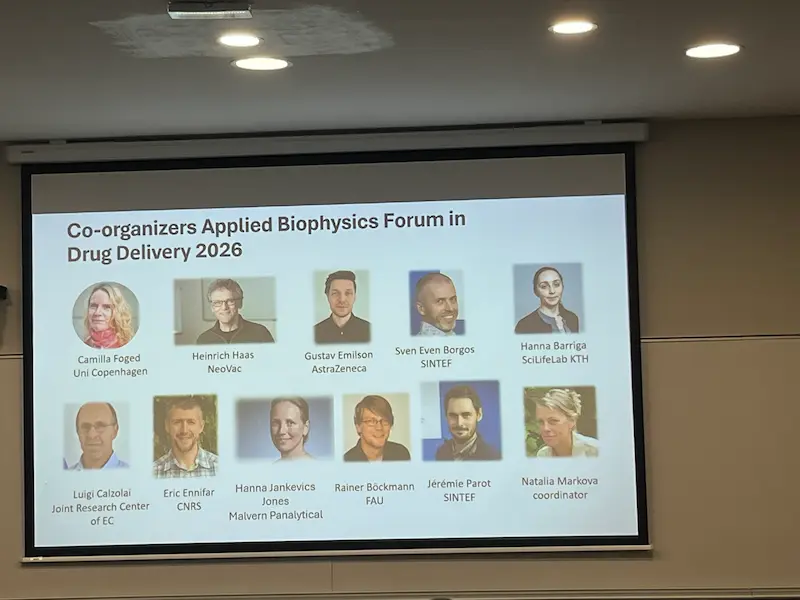
- Harmonization is the field’s defining challenge. The call for standardization spanned the practical (which analytics, which parameters to report, how much), the community (no shared benchmark; an approved product such as Onpattro proposed as a reference point), and the regulatory. The recurring point: the field is held back less by a shortage of methods than by the absence of agreed ones. The inter-laboratory activity-assay work by Sven Even Borgos and Luigi Calzolai was a concrete step toward a harmonized in vitro readout.
- Same size does not mean same function — characterization has to go orthogonal. DLS alone misses population, structure and composition (Federica Sebastiani); single-particle and structural methods filled the gap throughout — mass photometry (Refeyn), AF4 coupled to SAXS, neutron scattering, native MS, and field-flow fractionation. A recurring observation was cargo heterogeneity: not every particle carries RNA, and not in equal amounts. This is exactly where co-encapsulation measurement matters and where it remains genuinely hard to do. Inside Therapeutics contributed to that conversation with a poster and a five-minute talk on measuring co-encapsulation at the single-particle level, by in-gel multiplexed digital RT-PCR on the Chronos platform co-developed with BforCure.
- Endosomal escape: a small productive fraction, now becoming measurable. A galectin-based sensor for lipid-delivered RNA showed release directly — the RNA signal falls as the galectin signal rises — and confirmed that only a small fraction of cargo escapes. Endosomal damage was shown to occur even without cargo, and siRNA and mRNA behaved differently. This reframes “delivery” as the productive fraction, not the delivered dose.
- The process is part of the product. Formulation process & downstream steps matter more than they are usually credited. Particles formed at low pH and then diluted across a pH 3–8 range showed large, charge-independent size changes; adding mRNA altered the size and zeta behavior entirely; lower pH increased polydispersity and high ionic strength shifted CQAs. Bleb-containing (fusion) LNPs showed higher potency. On formation, the inverse hexagonal phase, when it forms directly, is too dense to encapsulate RNA — a structural transition is required, which has direct implications for process design.
- Regulatory translation lags the science but is moving with it. The framing from the industry/regulatory side: the active substance is the RNA, but what is injected is the LNP, and traditional frameworks are not tailored to that. The pragmatic path discussed was full orthogonal characterization plus comparability data — if you can show a process change does not alter the product, you do not have to re-prove everything.

Selected presentation highlights
We selected three talks for in-depth coverage based on the depth of data presented and on broader relevance for groups working on delivery, formulation, and translation.
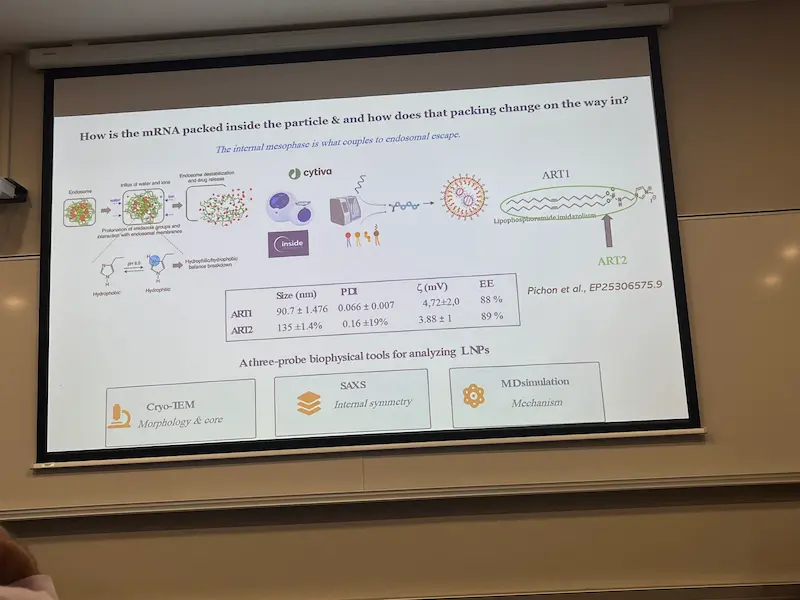
The process pH you are not looking at (Paul Stainton, AstraZeneca)
- Dilution and downstream steps (including TFF) matter more than commonly assumed; the question is what happens to the particle outside the mixing step.
- Systematic study: particles formed at low pH (citrate/phosphate) and then diluted across pH 3–8, tracked by DLS, showed large size changes that were not explained by surface charge. Adding mRNA changed the size and zeta behavior completely.
- Lower pH increased polydispersity; high ionic strength shifted critical quality attributes.
- Fusion-type, bleb-containing LNPs showed higher potency; high dilution (around 1:4) was discussed as a lever.
- Takeaway: process parameters are CQAs, and characterization needs to cover the whole process, not only the final particle.
Reading LNP formation through structure (Joachim Rädler, LMU Munich)
- Identical mRNA delivery can yield different protein expression, which points to the decisive events happening during and after endosomal uptake rather than at the membrane.
- Internal LNP packing changes with pH, and lipid phase transitions occur at different pH values for different components — a mechanism that can explain divergent behavior between otherwise similar formulations.
- Transfection efficiency relates to the internal water content and structure of the particle.
- Modifying the core changes interactions with the exterior and fusion with the cell membrane.
- On formation: when the inverse hexagonal phase forms directly, the structure is too dense to encapsulate RNA — a structural transition is required for encapsulation to occur.
In vivo CAR-T without the cell factory (Raymond Schiffelers, UMC Utrecht / NanoCell)
- The approach: engineer T cells directly in vivo with LNPs rather than through an ex vivo cell-manufacturing process, the direction being commercialized through NanoCell.
- Targeting: a fusion protein used as a ligand to direct particles to T cells. The result was T-cell specific — nothing on B cells — with expression concentrated in the spleen, the T-cell organ.
- Cargo: minicircle DNA encoding the CAR together with transposase mRNA (the integrating enzyme), reaching around 20% of CAR-T cells permanently transfected.
- Co-delivery: an attempt to carry two payloads in the same particle, read out by a NanoFACS-type single-particle labeling approach. Some particles showed dual signal, though co-loading was not yet convincing across the full population — a reminder of how hard single-particle cargo measurement remains. The team also used Sparta Bioscience approach for measurement of coencapsulation which gave more coherent and robust results
- Robustness: silencing one of the targeting antibodies still preserved function. Model: a humanized setting, with the mouse immune compartment replaced by a human one.

Further highlights from the conference
- Dan Peer (Tel Aviv University) — the opening keynote framed delivery as a system problem (lipid synthesis, ionizable-lipid design, lipids degrading their own RNA) and made the standardization case directly. Beyond vaccines, an mRNA-LNP construct protective against pneumonic plague (Yersinia) after a single dose, with antibody targeting via adaptor strategies.
- Yvonne Perrie (University of Strathclyde) — microfluidic manufacturing down to single-patient scale (cross-flow): particle size can shift across scales while biological activity in mice is preserved.
- Anders Wittrup (Lund University) — a galectin-based endosomal escape sensor for lipid-delivered RNA that quantifies release and shows how small the escaping fraction is; damage can occur even without cargo, and siRNA and mRNA do not behave the same way.
- Federica Sebastiani (University of Copenhagen) — DLS alone misses population, structure and composition; AF4 coupled to SAXS as the alternative. Substituting MGG1 for cholesterol changed particle size, while encapsulation efficiency stayed constant across fractions.
- Hanna Barriga (SciLifeLab / KTH) — the role of internal LNP structure in membrane interaction and endosomal escape; the same formulation made by different techniques gave the same EE but a different fraction of RNA-loaded particles; the inverse hexagonal phase is not essential for cell entry; stabilizer choice directly affects morphology.
- Chantal Pichon (ART-Inserm) — 3’UTR engineering to tune expression and cell targeting; two ionizable lipids (ART1/ART2) formulated using microfluidics on TAMARA, with ART2 improving saRNA delivery and forming EV/LNP hybrids compatible with nebulization, and ART1 better suited to surface decoration.
- Sven Even Borgos (SINTEF) & Luigi Calzolai (European Commission) — inter-laboratory harmonization of an in vitro mRNA-LNP activity assay; circulating the same samples across labs gave reasonable reproducibility but persistent variability, and an effort to link physico-chemistry to cell-based readouts.
- Philippe Talaga (Sanofi) — the RNA is the active but the LNP is injected; current frameworks are not adapted, and full orthogonal characterization plus process-comparability data is the pragmatic route.
- Analytics toolbox — native MS for RNA (Évolène Deslignière, CNRS ICSN); field-flow fractionation (Roland Drexel, Postnova/Malvern; Lars Nilsson, Lund University); molecular-level PEG orientation, with steps toward quantification (Morgan Alexander, University of Nottingham).
- Florian Grüner (University of Hamburg) — X-ray fluorescence imaging (XFI) to track and quantify labeled particles and immune cells in live mice.
- Caroline B. (JGU Mainz) — PEG as a possible driver of reactogenicity, and alternatives aimed at limiting anti-PEG antibody responses.
- Danny Incarnato (University of Groningen) — modeling the true in-cell RNA structure by incorporating binding information.
- Alberto Bianco (CNRS) — covalently functionalized graphene as a nucleic-acid carrier, with biodistribution to kidney, liver and urine.
Flash poster presentations
Two rounds of five-minute flash talks ran alongside the main program, and several were among the more concrete contributions of the two days.
- Ainhoa (Nalon Innova) — an analytical workflow for lipoplexes as an RNA delivery system.
- Anas Alj (University of Copenhagen) — two-step continuous manufacturing with a confined-impinging-jet mixer at 120 mL/min (empty liposome/LNP first, then empty LNP plus RNA).
- Catia Crespo (Refeyn) — mass photometry measuring the mass of single particles (TwoMP), including detection of dsRNA.
- Johnson & Johnson Innovation — evaluation of shear stress during processing and of protectants such as sucrose.
- Marius Trollmann (FAU Erlangen) — simulations showing that some lipids remain protonated at the particle surface.
- Miriam Grava (TU Darmstadt) — RNA adsorption reorganizes the lipids at the interface.
- Magdolna Budai (Polymun Scientific) — targeting LNPs.
- Valerija (Coriolis Pharma) — a characterization platform for nanoparticles.
Jun. 10 to 11, 2026 Where:
Strasbourg, France
Looking to get started or improve your LNP formulation screening?
Reach out to us to discover how we can help!
Other Conference Recaps
Looking for more insights from conferences? Check out other conference recaps to stay updated on the latest developments!
See all conference recaps
ASGCT | American Society Of Gene and Cell Therapy 2026, Boston
Read more
Joint EUFEPS-SITELF Meeting 2026 conference introduction
Read more
14th Galenus Workshop 2026 — RNA Therapeutics, Naples
Read more
LNP days 2026 by SF Nano
Read more