





Abstract
LNP scale-up is usually seen as a volume problem: the same nanoparticle, in bigger batches. It isn’t as simple as that.
RNA-LNPs are made by precisely mixing RNA and lipids together — a process that shapes every downstream property of the particle, from size to internal organization and biological behaviour — and mixing for low-volume screening is a fundamentally different exercise from mixing for large scale GMP production.
One wants precise mixing over a few hundred microliters; the other wants throughput over tens or hundreds of liters, and the technologies built to satisfy each requirement are not the same technology, hence don’t produce the same nanoparticle. This review walks through why that mismatch exists, how it shows up in the critical quality attributes (CQAs) of the particle itself, why the regulatory bar for proving a scaled-up LNP is “the same” LNP keeps rising, and how the field can actually move past it.
What LNP development actually needs from the formulation side
Preclinical development asks a formulation approach for something fundamentally different than GMP production does.
The first development step of an RNA-LNP product is screening. LNP screening is a mix of rational design and empirical testing: known lipid structure-activity relationships and ratios borrowed from approved products narrow the field early through DOE, but the link between composition, mixing, and biological performance is still too complex to predict from first principles alone. So it becomes a numbers game — a campaign spanning dozens to hundreds of lipid ratios and flow conditions, each competing for RNA (or lipids) that’s expensive and often available only in milligram quantities. What screening needs above all is the ability to make a small, information-rich batch without spending down the RNA budget on a single data point.
That means working volumes in the hundreds of microliters, fast turnaround between conditions, and fine control over flow parameters. Microfluidic mixing — laminar flow inside a fixed channel — is built for exactly this, which is why it’s the default at the development stage: not because it’s more sophisticated, but because it’s the only approach that efficiently works at screening volumes.
Requirements don’t jump straight from screening to production — they shift gradually as a program progresses through preclinical development. As candidates advance from in vitro screening into in vivo studies, the number of formulations under evaluation drops from hundreds down to a handful, while the volume needed per condition grows from a few hundred microliters to milliliter scale. By the time a single candidate is locked ahead of Investigational New Drug (IND)-enabling studies and subsequent clinical supply, volumes have grown again — into the hundreds of milliliters, and eventually tens or hundreds of liters — while the number of formulations has narrowed to just one.
Table 1. Typical formulation volumes, number of candidates, and mixing approaches across RNA-LNP development stages.
| Development stage | Typical formulation volume | Number of formulations | Typical mixing approach |
|---|---|---|---|
| Screening / in vitro | Hundreds of µL to a few mL | 10s-100s | Microfluidics |
| Preclinical in vivo | A few mL to tens of mL | 2-5 | Microfluidics |
| Phase 1/2 clinical | Tens of mL to ~100 mL | 1 | Microfluidics, transitioning to IJM |
| Phase 3 / commercial manufacturing | Hundreds of mL to tens or hundreds of L | 1 | IJM / T-mixers |
What LNP GMP production actually needs from the formulation side
Once a lead candidate is selected, the challenge changes from finding the right formulation to reproducing it reliably at scale. Clinical and commercial supply need volumes ranging from around 100 mL to tens or hundreds of liters, produced under GMP conditions and at a throughput that supports realistic clinical trial timelines. Precision in a single 200 µL batch is no longer the constraint; consistent performance across multi-liter runs is.
Microfluidic formulation of LNP
Microfluidics excels at development-scale formulation, but scaling it to GMP production is far more challenging. Its precision comes from a fixed, narrow channel (200 to 300 µm) operating under laminar flow — the same feature that makes it so controllable at low volumes also limits how much can pass through it. Pushing more volume through brings several challenges: increased risks of clogging and fouling due to the narrow channels and the natural tendency of nanoparticles to agglomerate; extremely long runs to maintain the same formulation conditions, which severely limit throughput; or raising the flow rate, which changes the formulation conditions and hence does not make the same nanoparticles. Running many chips in parallel to compensate — scaling out rather than scaling up — is also extremely challenging due to the pressure imbalances that can arise from clogging, leading to high risks of batch failures. Above roughly 50–100 mL, microfluidics stops being a viable production tool, not for lack of a bigger version, but because the property that makes it precise at low scale is the same property that limits its throughput.
Impingement jet mixing (IJM) and T-mixer formulation
IJM and T-mixers — colliding two high-velocity streams under turbulent flow — are what the industry has converged on to meet that need instead. It is fast, it scales to continuous operation, and it is genuinely well suited to large-volume LNP manufacturing. But it comes with its own rigid requirements: flow rates typically need to sit above tens of mL/min – meaning relatively large minimum operating volume and increased losses – to sustain the turbulence that makes the mixing work, it is extremely sensitive to even small flow rate changes, and — critically — the flow rate ratio between the two phases is generally locked close to 1:1, since deviating from it pushes mixing outside the chamber and degrades particle quality. At the volumes typically required for screening & preclinical testing, IJM is therefore not simply a smaller version of the same tool — it operates outside its optimal range and is not well suited to the workflows required for development.
Table 2. Comparison of microfluidic and IJM/T-mixer technologies for RNA-LNP formulation.
| Mixing technology | Optimal volume range | Typical throughput | Best suited for |
|---|---|---|---|
| Microfluidics | ~100 µL to ~50–100 mL | Low (batch-limited, mL/min flow rates) | Screening, preclinical, early clinical |
| IJM / T-mixers | ~10s mL and up, continuous | High (typically >10 mL/min, scalable to continuous L/h production) | Late clinical, commercial GMP manufacturing |
This challenge is not unique to RNA-LNPs. Biologics manufacturing runs into the same problem with bioreactors: conditions inside a bench-scale vessel don’t simply translate to a commercial-scale one [1]. “Just use a bigger vessel” is one of the most persistent myths in bioprocessing, as matching a single engineering parameter across scales doesn’t guarantee the same biological outcome. RNA-LNP scale-up runs into its own version of that lesson: matching lipid composition and N/P ratio across scales does not guarantee the same particles, because the mixing conditions that govern their formation have changed.
So, development and GMP production are therefore not the same process performed at different volumes. They are two different engineering problems, each solved today by a technology that is structurally unsuited to the other’s regime.
Table 3. Different engineering priorities in early-stage RNA-LNP development and GMP manufacturing.
| Development (screening & preclinical) | GMP production | |
|---|---|---|
| Priority | RNA economy, iteration speed | Throughput, continuity, GMP compliance |
| Consequences of poor process performance | Wasted RNA, unreliable screening data, slower optimization | Batch failure, CQA drift from the profile validated at bench |
What happens when you switch mixing technologies
So, development and GMP production don’t use the same mixing technology. But what actually happens when a program switches from one to the other?
Why the same particle doesn’t survive the switch
The short answer: the same nanoparticle doesn’t reliably survive the switch. Partly because the relationship between mixing conditions and particle properties is multiparametric rather than linear — change the flow regime and several CQAs shift simultaneously, not just one, and not in ways that cancel each other out. And partly because several of the properties that matter most still can’t be measured reliably, making it hard to confirm whether a “successful” technology transfer has actually preserved what matters.
“When you transition from preclinical small scale to large scale, you have to switch the mixing technologies, which costs time and money. You have to make sure that when you’ve changed the manufacturing process, you haven’t changed the drug itself — the nanoparticle, or how much of the mRNA gets into the LNP. It has to be the same.”
— Alex Aust, LNP Consultant, PharmaSource Podcast [2]
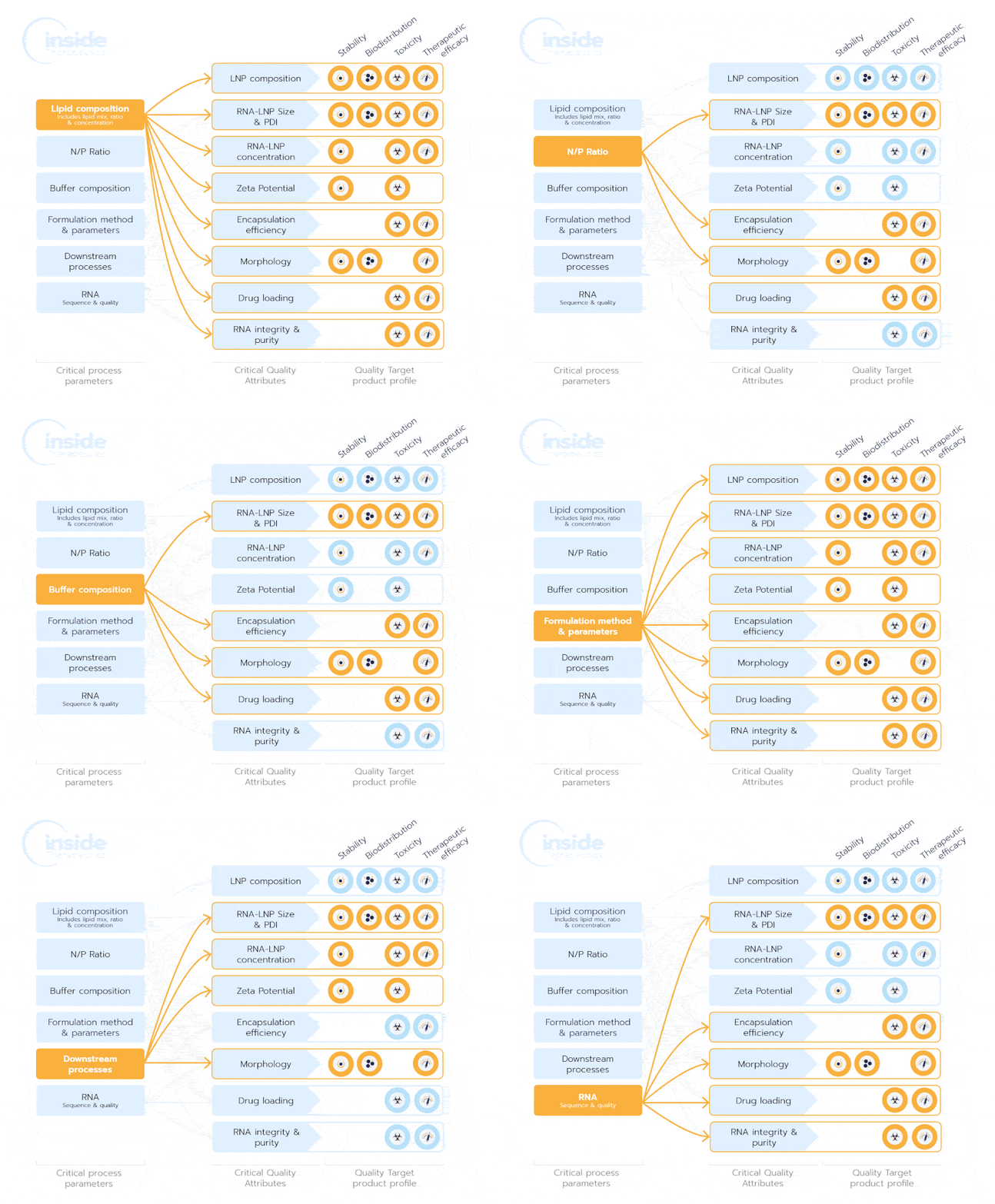
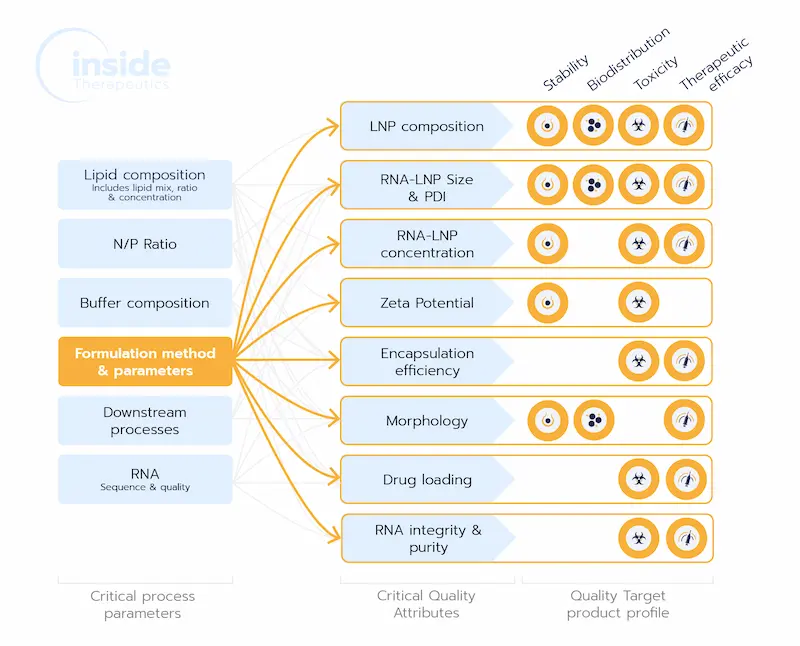
Part of why this happens is that an LNP is not a stable object you specify once and reproduce anywhere. It forms in milliseconds through nanoprecipitation, and even after formulation it stays metastable — the particle continues to evolve. That is precisely why mixing conditions leave such a lasting mark: the process is not incidental to the particle, it is constitutive of it. Formulation method sits upstream of nearly every CQA that follows — particle size, polydispersity (PDI), encapsulation efficiency, morphology, RNA integrity — and those CQAs in turn govern biodistribution, stability, and therapeutic performance, as the Figure 2 below lays out.
It’s worth being honest about a separate, unresolved issue here: several of the parameters that matter most — RNA-LNP internal organization, RNA copy number per particle, the ratio of full-to-empty LNPs, endosomal escape efficiency — still lack standardized and simple measurement techniques. That is a field-wide characterization gap, and no formulation technology closes it on its own. What a formulation technology can address is a related but distinct problem: keeping the process itself consistent enough that whatever CQAs you can measure stay stable across scales. That’s the process continuity gap, and it’s the one this review is really about.
“A main barrier to mRNA vaccine development and manufacturing is achieving reproducible LNP formulation and scale-up while maintaining key particle quality attributes across batches.”
— Robert Langer, MIT, via Nature Reviews Bioengineering [3]
The switch happens earlier than most teams realize
The same problem shows up in miniature even before a formal scale-up decision is made. Teams that hand-mix or pipette-mix early formulations — a common shortcut at the very earliest discovery stage — are often, without realizing it, already setting themselves up for the same disconnect:
“What many people end up doing is to just pipette-mix or hand-mix their components, which means that the LNPs you’re making are very different than the LNPs you’re going to be making farther down in your development process during scale-up. If you don’t think about that early on, you might end up optimizing for something that doesn’t end up being quite as good later on.”
— Colin McKinlay, Nutcracker Therapeutics, Pharmaceutical Technology (2024) [4]
What the data actually shows
The mechanism behind this is straightforward once you separate the two mixing regimes. As one industry analysis puts it:
“Scale-up often involves a change in the mixing technology itself — moving from microfluidic chips to impingement jet mixers or T-mixers. This shift in hydrodynamics can alter particle size distribution, encapsulation efficiency, and morphology, forcing teams to re-optimize formulations that were thought to be finalized.”
— Creative Biolabs, Scalability Challenges in mRNA-LNP Manufacturing (2026) [5]
A 2026 cryo-EM review of the field [6] shows this happening in practice: particles that look identical by DLS — same size, same PDI — can still exhibit markedly different morphologies and transfection outcomes, because it’s the mixing conditions during formation, not just the final composition, that determine what gets built inside. Switching only the mixing geometry, while keeping the lipid composition and RNA payload identical, shifted the proportion of one structural subtype (bleb-forming particles) from roughly 90% to roughly 30% of the population. Mixing technology alone is enough to change the nanoparticle, hence its biological behavior, including toxicity, biodistribution, and transfection performance.
A practical benchmark makes the same point in vivo: applying eleven different mixing techniques to the same mRNA-LNP formulation (same lipids, RNA, and downstream purification) produced bioluminescence expression ranging from roughly 10% to 250% relative to hand mixing — a 25-fold spread from the mixing method alone [7].
![Mean radiance (in vivo bioluminescence), relative to hand mixing, across eleven anonymized mixing techniques. Data: Bethiana, Ristroph, et al., bioRxiv 2025 [7].](https://insidetx.com/wp-content/uploads/2026/07/11-Mixer-comparison-for-LNP-formulation-1024x521.webp)
What this costs in practice
The fact that IJM’s flow rate ratio is essentially fixed near 1:1, as noted above, is exactly the kind of rigid process constraint that can force a full re-optimization campaign when a program makes the switch. Beam Therapeutics’ own account of its CRISPR-LNP development, shared at the 2024 NanoDDS conference in Orlando [8], put a number on it: the switch from microfluidic screening to IJM production alone took roughly 18 months of iteration in their program — before accounting for the rest of the development timeline.
The hybrid workaround: how biotech teams cope today
The scale of the bottleneck is easy to underestimate. As of mid-2026, only seven RNA-LNP drug products have reached approval worldwide: four from Moderna (Spikevax, mRESVIA, mNEXSPIKE, and the recently approved flu-COVID combination mCOMBRIAX), one from BioNTech/Pfizer (Comirnaty), one from Arcturus/CSL (Kostaive, approved in Japan), and one from Alnylam (Patisiran, the first LNP drug ever approved, back in 2018) [9]. Against a pipeline of hundreds of candidates in development, that is a strikingly small number — but the list continues to evolve, with Moderna expecting a fifth approval within months.
As introduced above, Beam Therapeutics’ 18 months CMC transfer is not an outlier; it’s close to the norm. In the absence of a single method that spans the full development pipeline, most biotech and pharma teams have settled into a hybrid workflow by necessity rather than design: microfluidics for screening and early in vivo work, a transition to IJM or T-junction mixing somewhere around the 50–100 mL mark (or at the end of the preclinical development), and a formal re-characterization campaign at every transition. In our experience working with formulation teams, that transition can take up to two years to complete end to end, largely because of the CQA discrepancies described above — and anecdotally, roughly one-third of microfluidic-optimized formulations don’t transfer cleanly and require significant re-optimization once they move beyond the scale for which they were developed. Neither figure represents published data; rather, they reflect what we consistently hear from teams living through the transition, not a formal study.
That repeated re-optimization is not free, and it is not just a manufacturing inconvenience — it is a direct constraint on how much confidence a program can have in its own delivery vehicle at the point it matters most.
“Even more than funding, the quality of the delivery vehicle is what is critical. If there’s any toxicity or issues with it, you have to start from scratch all over again — having an efficient, non-toxic, but also scalable and manufacturable vector is the most critical piece.”
— Fátima Bosch, Scientific Advisor, Kriya Therapeutics, at a Gene Therapy Summit 2026 roundtable [10]
Why LNP GMP scale-up is getting harder, not easier
It’s tempting to treat this challenge as solved — after all, mRNA-LNP vaccines already reached billions of doses. But this happened under emergency authorization, before any dedicated LNP quality framework existed. Those frameworks are now being written, and the next generation of RNA-LNP products — repeat-dose therapeutics, gene-editing payloads, non-vaccine indications — will not benefit from the same regulatory flexibility.
Three regulators are converging on the same ask. The European Pharmacopoeia adopted new general texts on mRNA-LNP products in 2024, in force since July 2025 [11]. The EMA has a dedicated mRNA-LNP quality guideline in development, already calling for batch-level consistency data [12]. The USP’s analytical procedures for mRNA vaccine quality have expanded twice since 2022 to add LNP-specific methods [13]. All three point to the same standard: demonstrating that a process change has not altered the product — a principle borrowed from small-molecule pharmaceuticals that is a poor fit for LNPs.
“The statement that ‘if you can show a process change does not alter the product, you do not have to re-prove everything’ may be tricky for LNPs: many potentially relevant structural features are not routinely measured — and maybe cannot even be measured yet. Consequently, demonstrating true product equivalence following a process change may be more difficult than for conventional pharmaceuticals.”
— Cédric Devos, MIT [14]
That’s exactly the requirement microfluidic-to-IJM transitions struggle to satisfy. A hybrid workflow that proved acceptable under emergency authorization becomes much more difficult to justify under a regulatory framework that expects process understanding and batch-to-batch consistency to be demonstrated by design.
How can LNP scale-up actually move forward
None of this means LNP scale-up is unsolvable — it means we need to ask a different question. Instead of assuming the mixing technology has to change between screening and production, the more useful question is what a mixing approach would need to do differently to avoid that change altogether.
The field has started asking for this directly. The eleven-mixer benchmark cited above closes by recommending that manufacturers of large-scale mixing technologies develop and validate scaled-down versions of their mixers, operable with material consumption comparable to a microfluidic system, so that bench-scale material is representative of what large-scale operation will produce [7], and that no hardware change should be required during scale-up, because any change to them will necessary lead to a change in RNA-LNP characteristics. That is the same conclusion reached from the other direction: the way out is not a better transfer, it is not transferring.
That is the specific gap that NanoPulse, developed at Inside Therapeutics, was engineered around — not the characterization gap described earlier (no technology closes that by itself), but the process continuity gap. NanoPulse is built on high-frequency alternating injection of two liquid phases into a shared channel, rather than relying on either laminar microfluidic flow or turbulent jet impingement. Because mixing happens at the interface between successive alternating fringes rather than through a volume-dependent flow regime, the same mixing conditions apply whether the total volume is a few hundred microliters (so only a few fringes are injected) or several liters delivered continuously — without a flow-regime switch and without the flow rate ratio constraint that locks IJM into a single operating point.

Why scaling by run time changes what has to be proven
This is a scaling route regulators already recognise. ICH Q13 allows a batch produced by continuous manufacturing to be defined by run time at a defined mass flow rate, and lists change in run time, with no change to mass flow rates or equipment, as a standard way to change production output. It also states that decreasing output below the longest run time previously validated generally does not imply additional risk, given the same equipment, process and control strategy [15]. The risks Q13 attaches to longer runs — process drift, material build-up, membrane or sensor fouling, exceeding component performance limits — are precisely what question 2 is designed to detect.
The principle fits in one line: the mixing conditions are identical by design, and the particles are shown equivalent by data.
What the data shows across scales
In practice, NanoPulse has shown to CQAs to remain consistent across µL to L scales, with matching in vitro and in vivo performance.
Continuous production has been demonstrated at volumes above 4 L, and in vivo performance has been shown to be equivalent to microfluidic TAMARA formulations in independent testing at the University of Strathclyde (Yvonne Perrie’s group). Against the limited commercially available options for scale-up today, NanoPulse offers unique approach with a single platform spanning the full screening-to-production range, built around one principle: the mixing conditions stay identical across scales, so the resulting particles do too. Learn more about it in our NanoPulse technology page.
None of this replaces the need for good characterization; the open questions about full-to-empty particle ratios, internal organization, and endosomal escape efficiency remain regardless of which mixing technology produced the particle. The challenge addressed here is different: preserving process continuity so that the particle characterized at screening scale is still the particle being made at production scale — which, for now, is the part of the problem that’s actually solvable.
Frequently Asked Questions on Lipid Nanoparticles
Why is LNP scale-up so difficult?
Because LNP formation is a kinetically driven self-assembly process, not a simple mixing step. The mixing conditions themselves define key nanoparticle characteristics such as particle’s size, encapsulation, and structure, so any change in mixing technology — including changes in flow conditions or the shift from microfluidics to impingement jet mixing that LNP scale-up pathways require — tends to produce a measurably different nanoparticle.
Why can’t I just use my screening formulation for GMP production?
Because the mixing technology that works well at screening volumes (microfluidics, operating under laminar flow) is structurally different from the technology used at production volumes (impingement jet mixing, operating under turbulent flow). The switch between them can change particle characteristics such as particle size, polydispersity, full/empty ratios, and morphology, even when the lipid composition and RNA payload are unchanged.
What is a CQA in LNP manufacturing?
A critical quality attribute (CQA) is a measurable property of the LNP — size, polydispersity index (PDI), encapsulation efficiency, morphology, RNA integrity — that directly affects safety, stability, or efficacy. CQAs are shaped by critical process parameters (CPPs) such as lipid composition, flow rate ratio, and downstream processing.
Is microfluidics or IJM better for LNP GMP scale-up?
Neither is universally better; they solve different problems. Microfluidics offers fine control at low volumes and dominates development, including screening. IJM provides the throughput needed for GMP-scale continuous production but cannot operate effectively at screening volumes. The scale-up problem exists precisely because a project typically needs both, at different stages.
Are LNP manufacturing regulations changing?
Yes. The European Pharmacopoeia adopted new general texts on mRNA-LNP products in 2024 (in force since July 2025), the EMA has a dedicated mRNA-LNP quality guideline in development, and the USP’s analytical procedures for mRNA vaccine quality have expanded significantly since their first 2022 edition to cover LNP-specific attributes. Products built under COVID-era emergency authorization will not automatically meet these standards.
What is NanoPulse?
NanoPulse is a patented formulation technology, developed at Inside Therapeutics, based on high-frequency alternating injection of two liquid phases into a shared channel. It is designed to keep mixing conditions — and therefore LNP — consistent from screening-scale volumes through continuous, multi-liter production to ensure smooth scale-up.

More quesiton about our NanoPulse Technology?
Talk to one of our LNP formulation experts!
Response within 24 hours. Your data is secure & never shared
References
[1] Bioreactor scale-up mixing-time/oxygen-transfer scaling — general bioprocessing principle.
[2] Aust, A. — Lipid Nanoparticles: Innovations and Challenges in mRNA Vaccine Manufacturing, PharmaSource Podcast. pharmasource.global
[3] Langer, R. — [DOI to be added; verify exact source before publication]
[4] McKinlay, C. (Nutcracker Therapeutics) — Pharmaceutical Technology (2024).
[5] Creative Biolabs — Scalability Challenges in mRNA-LNP Manufacturing (2026). creative-biolabs.com
[6] Mo, Y.; Zheng, G. — From Morphology to Mechanism: Cryo-Electron Microscopy Insights into Lipid Nanoparticles for RNA Delivery. ACS Nano 2026. doi.org/10.1021/acsnano.6c09354
[7] Beam Therapeutics — CRISPR-LNP development timeline, presented at the 2024 NanoDDS Conference, Orlando.
[8] Bethiana, T.; Aljabbari, A.; Li, Y.; et al.; Ristroph, K. — Identifying Differential Effects from Eleven Mixing Techniques on mRNA Lipid Nanoparticle Physicochemistry and Biological Performance. bioRxiv, 2025 biorxiv.org/content/10.1101/2025.11.07.687311v1.full
[9] Moderna, Inc. — Q1 2026 and Q4 2025 financial results and business updates. sec.gov
[10] Bosch, F. (Kriya Therapeutics) — Gene Therapy Summit 2026, roundtable remarks.
[11] EDQM — European Pharmacopoeia Commission adopts first three general texts on mRNA vaccines. edqm.eu
[12] EMA — Draft Guideline on quality aspects of mRNA vaccines. ema.europa.eu
[13] USP — Analytical Procedures for mRNA Vaccine Quality, Draft Guidelines. uspnf.com
[14] Devos, C. (MIT) — via LinkedIn.
[15] ICH — Q13: Continuous Manufacturing of Drug Substances and Drug Products, Step 4, 16 November 2022. EMA/CHMP/ICH/427817/2021. ema.europa.eu