


Book a demo
Tell us about your nanoparticle or RNA project and request Ntensify® micro and mini demo
Our team will get back to you shortly to schedule your session.
Contact
Any inquiries about RNA synthesis systems?
Drop us a line!

Contact
Any inquiries about your nanoparticle/RNA-LNP formulation?
Drop us a line!

Contact
Any inquiries about your nanoparticle/RNA-LNP formulation?
Drop us a line!
Book a demo
Tell us about your nanoparticle or RNA-LNP project and request a TAMARA demonstration.
Our team will get back to you shortly to schedule your session.
PreciGenome NanoGenerator: Flex-S, Flex-M, and Alternatives
The PreciGenome NanoGenerator range is a microfluidic mixing platform for lipid nanoparticle (LNP) formulation. It is a modular family of instruments, each covering a different volume window for a different development step, with a combination of several system needed to complete the whole workflow
What is the PreciGenome NanoGenerator platform?
The NanoGenerator line uses microfluidic mixing to formulate LNPs. Its two main R&D instruments are:
- NanoGenerator Flex-S – a discovery and screening system built around very low per-sample output (100 µL minimum) up to 1 mL
- NanoGenerator Flex-M – a preclinical system with a 1–12 mL throughput window.
The range is designed so you move up the ladder as your volumes grow: Flex-S for screening, then Flex-M for preclinical batches, with one instrument per step.
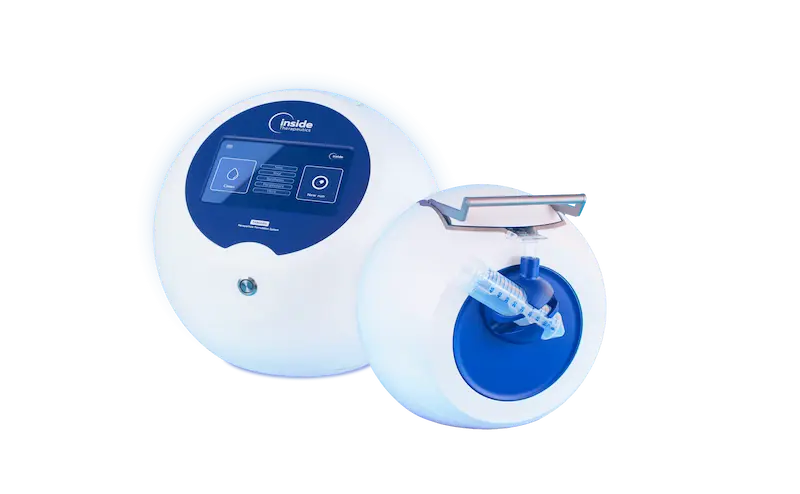
TAMARA by Inside Therapeutics takes the opposite approach for the R&D and preclinical range: a single benchtop platform covering 0.2 to 30 mL — screening, in vitro, and in vivo — using the same microfluidic mixing throughout. The nanoparticle you optimize at screening scale is made with the same mixing you use for your in vivo batch, with no instrument change in between.
Comparing TAMARA, Precigenome Flex-S & Flex-M
1 Inside Therapeutics published data.
2 PreciGenome NanoGenerator specifications — source to confirm before publishing (datasheet / Technical Note Flex System v3.0).
PreciGenome figures are taken from the publicly available product pages (precigenome.com), as of July 2026. Fields marked “Not specified” are not published on those pages. Points marked ² should be backed by PreciGenome’s own datasheet reference before publishing (see note to editor).
Why Choose TAMARA Over Precision Nanosystems ?

One platform, one mixing — the same nanoparticle from 0.2 to 30 mL
This is the core difference. With the NanoGenerator range, screening happens on Flex-S and scale-up happens on Flex-M — two different instruments. Every time you change the mixing hardware between stages, you risk changing the nanoparticle, and you may have to re-optimize what you already validated. TAMARA runs the same microfluidic mixing across its entire 0.2–30 mL range, so you carry one formulation from screening straight through to your in vivo study on the same machine.

Flow-rate range that actually reaches small nanoparticles
Small LNPs need high total flow rates to drive fast mixing. TAMARA’s TFR runs continuously up to 15 mL/min. A preclinical unit whose TFR is capped around 5 mL/min can struggle to push a formulation down to the smallest, most monodisperse particles, and fixed flow-rate setpoints (as on the screening unit) leave you tuning by presets rather than by the value you actually want.
Zero Formulation losses
TAMARA’s design permits zero formulation losses – so no waste of formulation material at any volumes
Reproducibility you can cite
TAMARA’s performance is published, not asserted: CV < 5% batch-to-batch, PDI < 0.2, and encapsulation efficiency up to 98% (SM-102 and ALC-0315). Reproducibility is the whole point of a microfluidic formulation platform — so it should come with numbers.
Why Choose Flex S?
4 formulations in paralell
The Precigenome Flex S can run up to 4 formulations in parallel in a single run
Why Choose Flex M?
A self-contained unit
The Flex Range by Precigenome doesn’t need an external compressed-air supply, whereas TAMARA does require one.
Still not sure which RNA-LNP formulation system to use?
Check this comment from one of the TAMARA Users
Hear from our users

Prof. Raymond Schiffelers
It’s only through daily use that the true value of a machine becomes apparent. When PhD students consistently gravitate toward one device while overlooking others, it speaks volumes. Tamara is in high demand — an endorsement in itself

Prof. Maria Jose Alonso
Our laboratory has been utilizing the TAMARA microfluidic device for nanoparticle preparation, which has enhanced our research capabilities. The microfluidic device offers an adequate combination of precision, scalability, and usability that sets it apart.

Dzenan Kovacic
We’ve set up TAMARA and performed our first mock run. I’m absolutely blown away by how user friendly, efficient and straight to the point this system is!


Want to try it?
Contact us
NanoGenerator vs TAMARA: which platform should you choose?
- Flex-S handles ultra-low-volume screening (down to 100 µL, up to 4 in parallel) and runs as a standalone unit, but with fixed flow-rate setpoints and a separate instrument needed to scale.
- Flex-M / Premium covers the preclinical range, but doesn’t reach screening volumes, carries head-and-tail losses, and caps TFR around 5 mL/min.
- TAMARA covers screening to in vivo (0.2–30 mL) on one platform, with the same mixing across the whole range for nanoparticle consistency at scale, two mixing geometries, continuous TFR/FRR control, zero losses, and reproducibility you can cite.
Looking to learn more about TAMARA?
Reach out to us to learn how we can help!