Tell us about your nanoparticle or RNA project and request Ntensify® micro and mini demo Our team will get back to you shortly to schedule your session.
Loading specific message...
Contact
Any inquiries about RNA synthesis systems? Drop us a line!
Loading specific message...
Contact
Any inquiries about your nanoparticle/RNA-LNP formulation? Drop us a line!
Loading specific message...
Contact
Any inquiries about your nanoparticle/RNA-LNP formulation? Drop us a line!
Loading specific message...
Book a demo
Tell us about your nanoparticle or RNA-LNP project and request a TAMARA demonstration. Our team will get back to you shortly to schedule your session.
InsideTx selected Elveflow for its EOM microfluidic integration.
Published: 21st of March 2025
Microfluidics is transforming how biological and chemical processes are designed, monitored, and scaled. While historically driven by academic research, microfluidic technologies are now increasingly adopted by industrial players seeking higher reproducibility, finer control of experimental conditions, and faster iteration cycles.
As a recognized player in precision microfluidics, Elveflow has developed fluid control technologies that have become essential building blocks across a broad range of life science applications, from fundamental research laboratories to industrial environments. Elveflow develops pressure-driven microfluidic systems enabling precise flow control, real-time monitoring, and automation for applications including cell culture, organ-on-chip models, particle synthesis, cosmetics, and advanced material testing.
To address the growing needs of industrial users, Elveflow has also developed a new range and OEM solutions specifically designed for two major profiles of companies: emerging startups looking to rapidly integrate reliable microfluidic building blocks into their own platforms, and established industrial groups aiming to scale microfluidic processes directly at the production level.
This evolution reflects a broader shift in the role of microfluidics within industrial workflows. The example of Inside Therapeutics illustrates this transition particularly well. In such cases, microfluidic control is no longer a peripheral laboratory tool but becomes a structuring component of the value chain itself, enabling robust, scalable, and reproducible production processes.
This article highlights how industrial-grade microfluidic instrumentation can support applied research and innovation through robust, automated, and scalable workflows.
Precise flow control as a foundation
Many microfluidic applications rely on stable, pulsation-free flow and fast response times. Elveflow systems use pressure-driven flow control combined with high-resolution flow sensors to ensure accurate and reproducible fluid handling, even at very low flow rates. This approach is particularly relevant for applications where syringe pumps reach their technical limits.
Pressure-driven flow control is a microfluidic actuation strategy in which fluids are moved through microchannels by precisely regulating the pressure applied at the inlet reservoirs, rather than by imposing a fixed volumetric displacement as in syringe-based systems. By directly controlling pressure, this approach enables fast response times, smooth and pulsation-free flow, and excellent stability at very low flow rates.
Microfluidics for Industry: OEM Integration and Scalable Fluidic Control
Microfluidics has long been associated with academic laboratories and proof-of-concept studies. Today, however, industrial stakeholders increasingly rely on microfluidic technologies to improve process robustness, experimental throughput, and data quality. Elveflow designs and manufactures pressure-driven microfluidic instrumentation specifically developed to meet these applied research and industrial needs.
Elveflow Instruments for OEM industrial integration
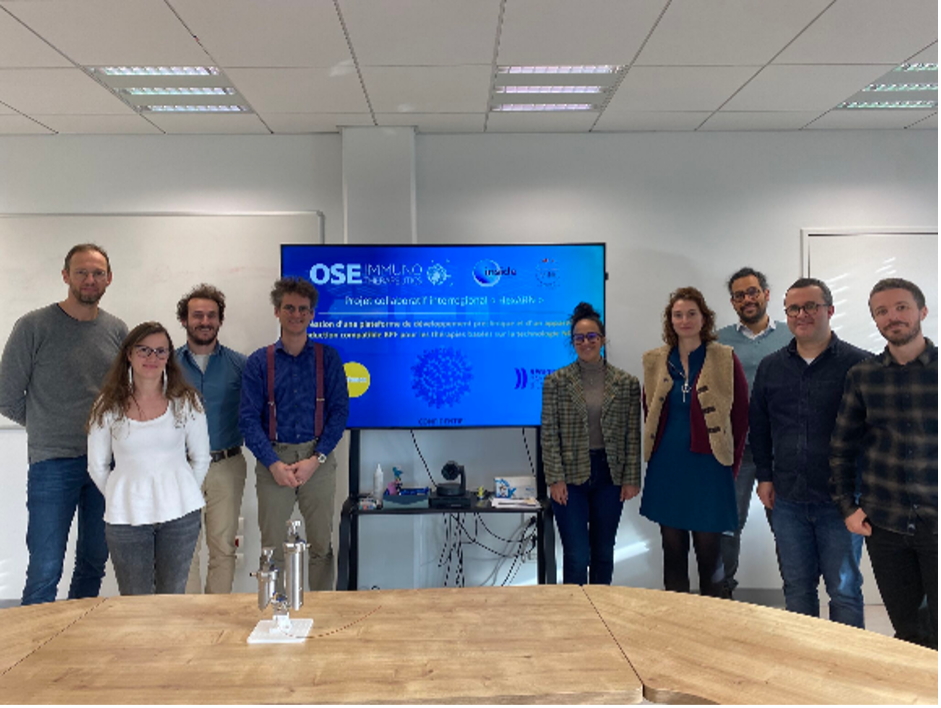
Elveflow technology powering the Inside Therapeutics TAMARA platform
The TAMARA platform developed by Inside Therapeutics integrates Elveflow’s pressure-driven flow control technology as the core fluidic actuation engine of the system. By embedding the OEM version of the OB1 pressure controller, TAMARA benefits from precise, stable, and programmable flow regulation, a critical requirement for the reproducible synthesis and handling of lipid nanoparticles (LNPs).
Inside Therapeutics needed a fluid control solution capable of combining several challenging requirements simultaneously: precise handling of very low liquid volumes, zero sample loss, rapid response time, and highly stable flow conditions. These parameters are essential for controlling nanoparticle physicochemical characteristics such as size, polydispersity index (PDI), zeta potential, and encapsulation efficiency, especially in RNA-LNP formulations where reagents are particularly valuable.
The integration of Elveflow’s pressure regulation technology was selected because pressure-driven flow control offers a unique balance between responsiveness, stability, and repeatability. Elveflow’s pressure-driven technology enables complete sample injection with virtually no dead volume losses while maintaining highly homogeneous flow conditions throughout the synthesis process.
Within the platform architecture, Elveflow’s pressure-driven technology is integrated into a touchscreen-based controller that serves as the graphical user interface. Users define synthesis parameters including total flow rate (TFR), flow rate ratio (FRR), and injected volume, while the system automatically converts these parameters into highly precise pressure values applied to the reservoirs connected to the microfluidic synthesis module.
The synthesis module itself contains the liquid reservoirs and the microfluidic chip where fluid mixing triggers nanoparticle formation. Both components are pneumatically connected, resulting in a compact tubing-free system that simplifies integration while minimizing dead volume and contamination risks.
A major advantage of Elveflow’s pressure-driven technology in this application lies in its fast response time and contactless fluid actuation. This allows TAMARA to efficiently process a wide range of volumes, from as little as 200 µL up to several milliliters, with excellent reproducibility and without sample losses. Such flexibility enables the same platform to be used from early formulation screening phases to preclinical development workflows.
The non-contact nature of pneumatic flow control also reduces cross-contamination risks and simplifies cleaning procedures, which is particularly important in pharmaceutical environments.
By integrating Elveflow’s OEM microfluidic technology, Inside Therapeutics was able to develop a platform combining advanced nanoparticle formulation capabilities with a user-friendly workflow accessible even to users without prior expertise in microfluidics. This collaboration illustrates how industrial microfluidic technologies are increasingly becoming central enabling components in next-generation bioproduction and nanomedicine platforms.
From prototyping to robust workflows
As an industrial partner, Elveflow supports users beyond instrumentation delivery. Our systems are designed to be modular and scalable, allowing researchers and engineers to move from early prototypes to more complex, automated setups without redesigning their entire fluidic infrastructure.
Conclusion
With Elveflow, microfluidics is no longer limited to academic exploration. With robust, precise, and flexible instrumentation, it becomes a powerful tool for applied research and industrial innovation. Elveflow positions itself as a technological partner enabling these applications by providing reliable microfluidic flow control solutions adapted to real-world constraints.
About
Inside Therapeutics (Inside Tx) is a french start up based in Bordeaux (France). The company designs, develops and markets instruments and services for manufacturing RNA-based lipid nanoparticles and liposomal products.
Contact: contact@insidetx.com
Elveflow develops a range of state-of-the-art microfluidic instruments, for all kinds of microfluidic applications. Our microfluidic systems can be used in many different fields, such as biology, chemistry, drug delivery, but also for cosmetics and food.
Contact: contact@elveflow.com
Looking to get started or improve your LNP formulation screening?
Reach out to us to discover how we can help!
More partnerships
Latest Partnerships and Collaborations from Inside Therapeutics Stay informed with the latest partnerships, insights, and milestones from Inside Therapeutics.