Sep. 10 to 11, 2026





Tell us about your nanoparticle or RNA project and request Ntensify® micro and mini demo
Our team will get back to you shortly to schedule your session.
Any inquiries about RNA synthesis systems?
Drop us a line!

Any inquiries about your nanoparticle/RNA-LNP formulation?
Drop us a line!

Any inquiries about your nanoparticle/RNA-LNP formulation?
Drop us a line!
Tell us about your nanoparticle or RNA-LNP project and request a TAMARA demonstration.
Our team will get back to you shortly to schedule your session.
Home Resources Conference recaps
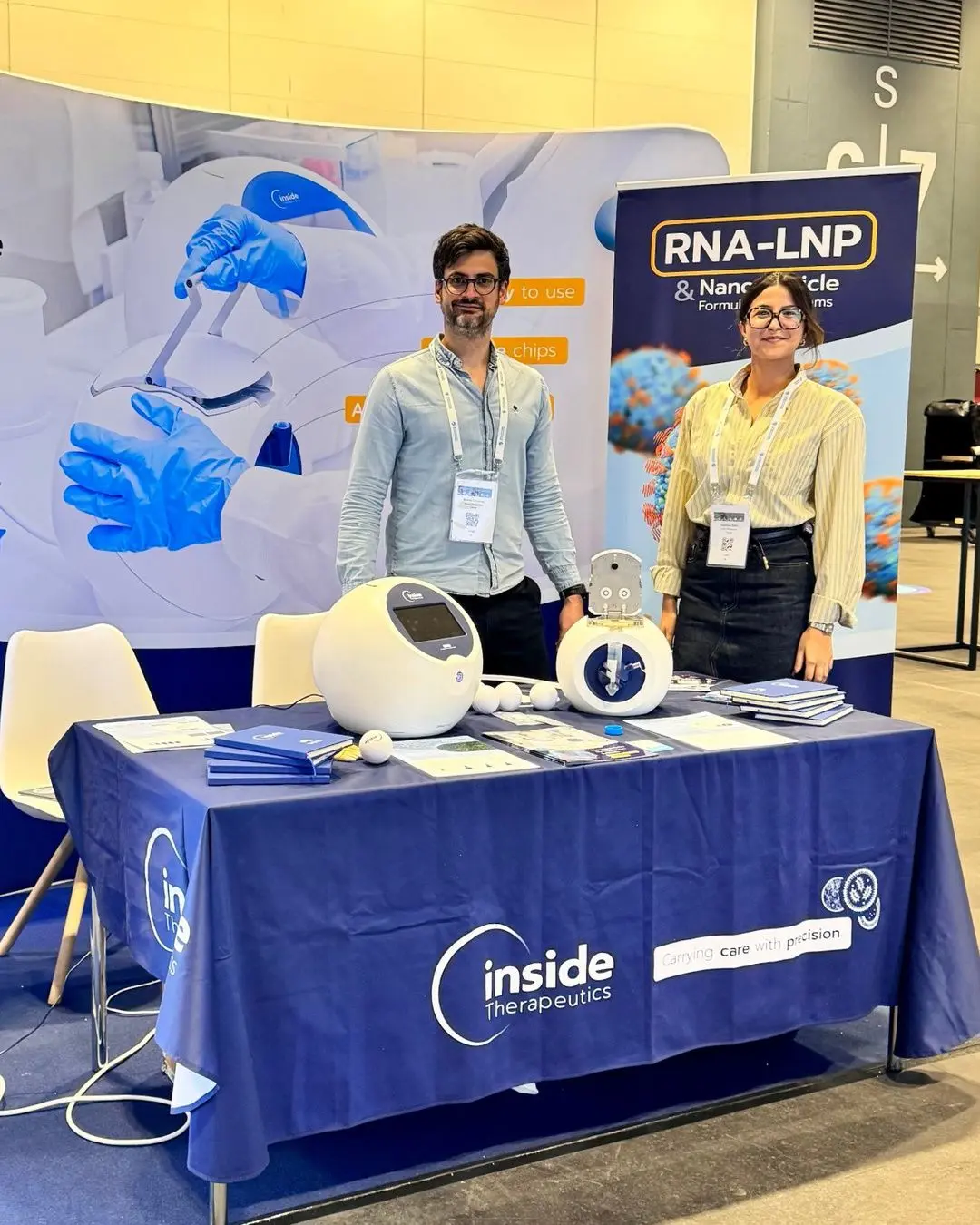
Four talks spoke directly to how RNA-LNPs are made rather than only to what they carry. Taken together, they describe the same shift from different angles: the order and conditions of the formulation steps now carry as much weight as the molecules going in.
The talk started from a distinction that often gets flattened. A vaccine and a gene editing therapy place different demands on the same delivery vehicle, so a formulation optimised for one is not a starting point for the other. From there the argument moved to process.
Going from small to large scale means working faster and in larger volumes, and the question is whether the particle coming out is still the same particle. Dialysis and tangential flow filtration were used as the worked example: two routes to the same nominal buffer exchange that do not leave the LNP in the same state, because an LNP after mixing is a kinetically trapped structure that keeps evolving during downstream handling.
Three points highlighted in the talk:
The practical consequence for anyone moving a formulation forward is that RNA-LNP is a product of RNA + Lipids + process. Hence, any process change has to be considered as a formulation change.
Targeting mRNA-LNPs is usually approached in one of three ways: passively, actively through a ligand conjugated to the surface, or by working with the endogenous protein corona. This talk, from Christian Buchholz’s Molecular Biotechnology and Gene Therapy group in Langen, takes the third route and inverts its usual logic.
The corona itself was presented as layered rather than uniform, with a hard corona in direct contact with the particle and a softer, more loosely associated outer population, so what a cell receptor meets is the result of protein-to-protein interactions as much as protein-to-lipid ones. Apolipoprotein E sits among the most abundant proteins in that layer and is the one that drives hepatic tropism through the LDL receptor.
Instead of suppressing that interaction, the group fuses a DARPin, a designed ankyrin repeat protein selected against a chosen receptor, to ApoE. The fusion anchors itself to the particle through ApoE’s own lipid-binding region, so the address is carried by the protein that would otherwise send the particle to the liver. ApoE variants were used along a decreasing LDLR-affinity axis, the principle being that lowering residual receptor affinity should leave more of the targeting to the DARPin arm.
What makes this relevant to formulation rather than only to targeting is where the step sits. The coating is applied to pre-formed LNPs and followed by buffer exchange, with no co-formulation and no PEG-lipid chemistry. One batch of particles can therefore be directed to different cell types by changing only the protein added afterwards, which simplifies the CMC picture considerably compared with building a separate targeted particle for each address. Particle size increases measurably after coating while dispersity stays in the same range, so the step is visible in routine characterisation.
Selectivity held up better in whole blood than in isolated primary T cells, where the untargeted ApoE arm still recruits LDLR. Serum components raise the background, which makes the complex-milieu experiments the meaningful test rather than the clean ones. The group described work extending the same architecture to receptors beyond CD8, including solid tumour targets, by swapping the DARPin while keeping the particle unchanged. [1]
DNA-LNP work has been held back by the innate sensing of double-stranded DNA, which activates cGAS-STING and induces cytokines. The platform presented here delivers circular single-stranded DNA to T cells in targeted LNPs, and under the conditions tested that cssDNA was not measurably sensed through the same pathway, which allowed high systemic doses without detectable cytokine induction.
The appeal over mRNA is duration and payload size. cssDNA supports longer transgene expression and can encode larger or more complex constructs, with comparable manufacturability. The platform is configurable in two directions: episomal CAR expression with no permanent genome modification, or use as a donor template alongside site-specific editing machinery for insertion at a defined locus. That choice lets expression duration be matched to the indication.
Delivery specificity came from the tLNP formulation itself. Biodistribution showed enrichment in spleen and lymphoid compartments with efficient delivery to T cells, while liver exposure stayed low. After intravenous administration, CAR-expressing T cells were generated in vivo, expanded, and retained effector function; in disseminated tumour models they controlled and cleared established disease, with no cytokine-mediated or systemic toxicity reported in the tissues evaluated.
This is in vivo T-cell engineering, a different paradigm from the ex vivo manufacturing route, and the constraint it shifts is the one that matters commercially: the cell product is made inside the patient, so the scalable unit becomes the formulated particle.
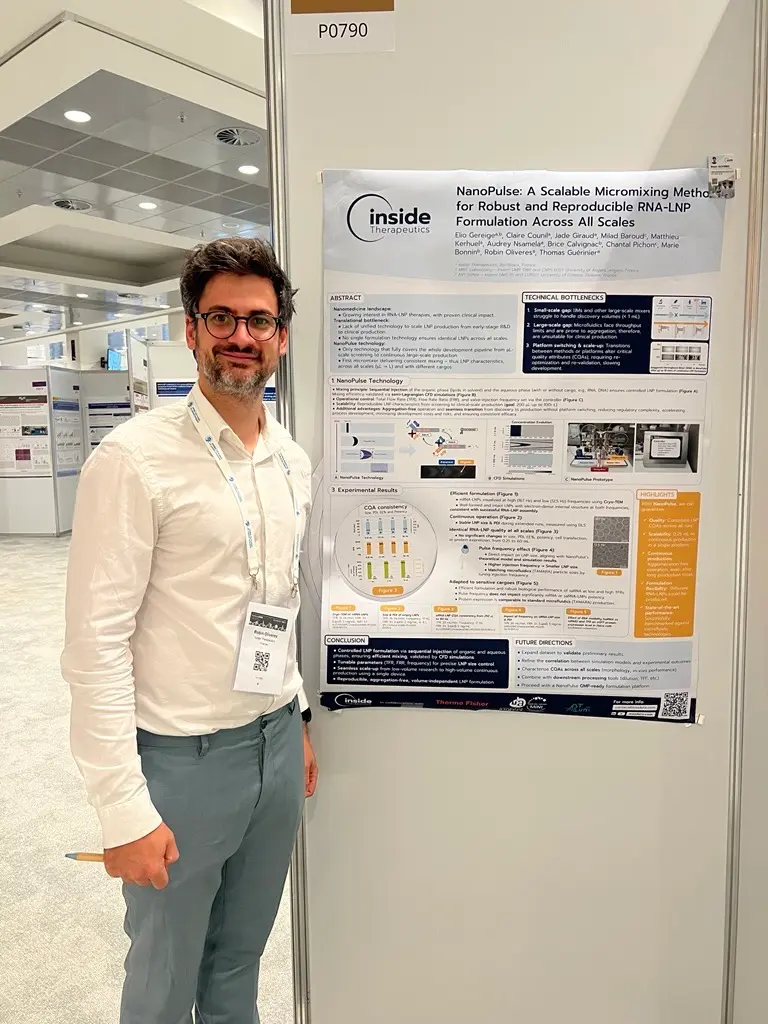
Figure 2. NanoPulse poster presented by Robin Oliveres at ESGCT 2026
The therapeutic logic for sickle cell disease is to reactivate gamma-globin by recreating, on purpose, the mutations found in people with hereditary persistence of fetal haemoglobin. Those carriers are asymptomatic, which gives the approach a natural efficacy benchmark rather than an arbitrary one.
Nuclease-based editing reached the clinic first and produced good results, but the talk made the case for moving away from double-strand breaks: in haematopoietic stem and progenitor cells, breaks induce an apoptotic and inflammatory signature, and in sickle cell disease they can aggravate an HSC inflammatory profile that is already abnormal. Three break-free or break-light alternatives were compared: base editing through a nickase fused to a deaminase, prime editing through a nickase with reverse transcriptase and a pegRNA, and epigenome editing through a catalytically dead Cas9 carrying an effector that writes histone marks or DNA methylation.
On safety, whole-exome sequencing and RNA-seq across three donors found no guide-independent off-target A-to-G changes in base-edited HSPCs, which is the specific risk adenine base editors carry. On the epigenome side, effectors based on CBP and Tet1 reactivated fetal haemoglobin to levels placed against the range seen in asymptomatic carriers, with sickling reduced accordingly, and optimisation of the protocol and of additional targets was described as ongoing.
The translational arm is BE-DREP, a 2024 to 2028 programme building a preclinical platform for base-edited HSC therapy in sickle cell disease. Its work packages read as a manufacturing plan: development of GMP processes, biosafety studies in vitro and in vivo, then transfer to GMP with validation runs and CMC work, aiming at a clinical trial authorisation within about four years.
The part most relevant to formulation came last. The ex vivo route carries apheresis, specialised facilities and hospitalisation, loss of stemness during culture, and myeloablative conditioning. An in vivo route removes all three, and the vehicle proposed for it is the LNP. Adenine base editor mRNA delivered in LNPs to human sickle cell HSPCs was assessed on viability, cell growth, editing and phenotypic rescue, with the conclusion that LNPs edit HSPCs safely and rescue the sickle phenotype. A parallel line of work applies the same comparison to fetal human HSPCs for prenatal intervention, where LNP-treated cells kept a healthier apoptotic profile and expanded better than electroporated ones.
The obstacle named for in vivo delivery was the bone marrow itself. Chronic inflammation, oxidative stress and apoptosis in the sickle cell marrow may alter the niche enough to affect how well HSCs can be reached and edited in place.
Across these, the recurring gap was not a biological one. Several speakers described formulations that work at the scale their study required, with no clear route to keeping the same particle at the scale a clinical programme would need. Mixing technology that holds its conditions constant from screening volumes to continuous production remains the open problem in that chain, and it was discussed more as an acknowledged constraint than as a solved one.
[1] S. A. Theuerkauf et al., “ApoE2-DARPin fusion proteins enable selective RNA transfer to CD8 T cells by lipid nanoparticles,” Journal of Controlled Release, vol. 388, p. 114377, 2025, doi: 10.1016/j.jconrel.2025.114377.
Talks reported above without a reference number were presented as communications at the ESGCT 33rd Annual Congress, Hamburg, 27 to 30 October 2026, and are not associated with a published article at the time of writing.


Reach out to us to discover how we can help!
Looking for more insights from conferences? Check out other conference recaps to stay updated on the latest developments!
See all conference recaps